The FIA approved the sale of WRC Promoter GmbH to the French group Cosmobilis and the private credit fund Park Square Capital. The operation closes thirteen years of management by Red Bull and KW25 at the helm of the commercial rights of the World Rally Championship and the European Championship, and places Eric Boullier as the new promoter's chief executive officer.
A director who comes from Formula 1
Boullier, a French mechanical engineer, built his reputation at the DAMS team, with which he won several GP2 championships between 2003 and 2009. He joined Renault in 2010 as head of the project that later became Lotus F1 Team, where Kimi Räikkönen won in Abu Dhabi 2012 with a budget far smaller than that of Ferrari or McLaren. His spell at McLaren, between 2014 and 2018, coincided with Honda's return as an engine supplier and with one of the most difficult periods in the British team's history. Boullier resigned in 2018, taking responsibility for the results. Afterwards, he directed the return of the French Grand Prix, an event that was operationally sound but criticised for unexciting races and low attendance at some editions. He has no prior history of sanctions or financial scandals, which is rare among motorsport executives. His biggest question mark is that he has never worked in rallies nor organised WRC events.
 Photo By Red Bull Content Pool
Who are Cosmobilis and Park Square Capital
Cosmobilis, founded in 2021, does not manufacture cars. It brings together dealership, vehicle rental, financing and software businesses for the sector, with a presence in more than thirty countries and commercial links with more than thirty manufacturers. Its president, Jean-Louis Mosca, has a son who competed in WRC2, a detail that helps explain the group's interest in a business so far from its usual activity. Park Square Capital provides private credit capital and experience in long‑term investments in Europe and the United States since 2004. Neither company has previously managed an international sporting championship, which is why the FIA subjected the consortium to a strict review of its financial soundness, organisational structure and medium‑term business plan.
What the Red Bull era left behind
Red Bull and KW25 took control of the commercial rights in 2013 and, after more than a decade of investment, decided to sell their stake to monetise the project. The balance of that period is mixed. Television coverage went from limited highlights to a near‑complete system, with the leap from WRC+ to All Live in 2018 and its subsequent evolution into Rally.TV. Audience grew: in 2025 the championship accumulated 1.3 billion television viewers, more than nine million active users on its official website, and a strong jump in video views, driven in part by the documentary series More than Machine, which broadened its young and female audience. The calendar regained events in Chile, Paraguay, Croatia and Saudi Arabia.
The problem that was never solved: manufacturers
In thirteen years, no major manufacturer joined the Rally1 category. Toyota, Hyundai and M‑Sport Ford are the only manufacturers after Citroën's departure in 2019 and Volkswagen's exit before that era began. The top‑class grid hovers between eight and ten cars depending on the event. Compared to Formula 1, MotoGP or NASCAR, rally remains a niche product, with much of its content behind the Rally.TV paywall.
 Photo By Red Bull Content Pool
The ground inherited by the new promoter
The WRC27 regulations, scheduled for 2027, set a cost cap of €345,000 per car and aim to open the door to major manufacturers and independent preparers. The FIA has also created a growth fund to finance grassroots motorsport development projects. The planned return to the United States, with a candidate event in 2026 and the possibility of joining the calendar in 2027, is another of the heaviest items on the agenda, because it would open a large market and encourage interest from new manufacturers.
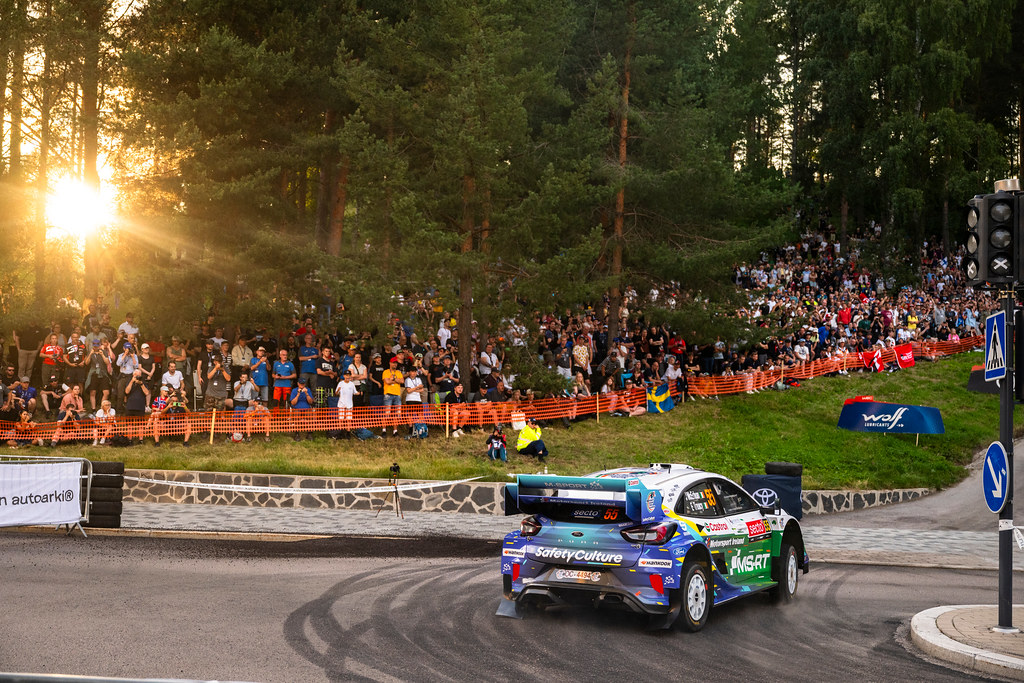 Photo By Red Bull Content Pool
What the protagonists said
Mohammed Ben Sulayem, the FIA president, described the transaction as the largest in the history of these championships and acknowledged the work of sporting vice‑president Malcolm Wilson, who has been involved with the WRC for more than forty years. Wilson stated that he had never seen an investment of this size in rallying and that the sale process sought a partner capable of understanding the championship's character, not just its commercial potential. Mosca said that the purchase serves as a platform to connect manufacturers, media and technology around rallying. Boullier set the goal of turning every round of the calendar into an event capable of attracting new followers.
The remainder of the 2026 season continues under the operation of WRC Promoter GmbH, with Jona Siebel as managing director, and the transition will proceed as approved by the FIA. The new promoter starts with two immediate tasks on the table: ensuring that WRC27 really reduces costs and that the Rally1 grid does not depend on three manufacturers for another decade.
-
 Carlos Castillo Sansabas

Upcoming Races
Drivers Standings 2026
| POS | PILOTO | PTS | ↕ |
|---|---|---|---|
| 1 | Elfyn Evans | 230 | |
| 2 | Sami Pajari | 213 | |
| 3 | Oliver Solberg | 209 | |
| 4 | Sébastien Ogier | 171 | arrow_up2 |
| 5 | Adrien Fourmaux | 167 | |
| 6 | Takamoto Katsuta | 163 | arrow_down2 |
| 7 | Thierry Neuville | 129 | |
| 8 | Hayden Paddon | 38 |
Manufacturers Standings 2026
| POS | CONSTRUCTOR | PTS | ↕ |
|---|---|---|---|
| 1 | TOYOTA GAZOO RACING WRT | 614 | |
| 2 | HYUNDAI SHELL MOBIS WORLD RALLY TEAM | 410 | |
| 3 | TOYOTA GAZOO RACING WRT2 | 227 | |
| 4 | M-SPORT FORD WORLD RALLY TEAM | 152 |

Toyota Wins Its Tenth Manufacturers' Title at the Rally Chile

Oliver Solberg Leads the Rally Chile Bio Bío Going into the Final Day

Sami Pajari Wins in Paraguay, Securing His Third Consecutive Victory in the WRC

The WRC Paraguay Rally Kicks Off with Pajari in the Lead and Two Withdrawals

The W2RC announces its 2027 schedule with five events

Latvala returned to competition and was the fastest Rally2 driver in Finland

Sami Pajari's Second Consecutive Victory in the WRC

Ogier leads in Finland, with Evans, Pajari, and Solberg trailing on Day 2

The Rally of Finland Kicks Off with Fourmaux in the Lead

Julien Ingrassia Returns to the WRC with Ogier for the Rally of Finland

Sami Pajari wins his first WRC event in Estonia and moves up to third place in the 2026 championship
