The NTT IndyCar Series today unveiled the first renders of the IR-28, the car that from 2028 will replace the DW12, the chassis the category has used since 2012 and which survived three major reforms without changing its monocoque. The new car arrives with 45 fewer kilograms, a 2.4‑litre V6 biturbo engine with 760 horsepower and a hybrid battery that multiplies the storage capacity of the current system by fourteen.
 Photo By Penske Entertainment
The DW12 was born in 2012 as a chassis designed to reduce costs and improve safety, and over more than a decade it accumulated updates that kept it competitive without increasing teams' spending. In 2018 it received the IR‑18 universal aero kit, in 2020 the aeroscreen was fitted, and in 2024 it was electrified with a low‑voltage hybrid system that forced a redesign of the gearbox and electronics. That philosophy of continuous evolution allowed the championship to maintain one of the highest levels of parity in the world, but it also pushed the car to a development limit. The monocoque remained the same as in 2012. Each new component was integrated onto a structure that was never designed to house it.
Against that inertia, the IR-28 starts from a completely new survival cell, wider to accommodate drivers of different sizes and with improved cooling ducts. The aeroscreen is no longer an add‑on and is integrated into the chassis architecture, reducing weight and improving aerodynamic penetration. The side impact structures have been redesigned to absorb more energy, and the car tends to stay on the ground in incidents where the current one could lift or spin out of control. The 45‑kilogram weight reduction puts the new car below 765 kilograms on permanent road courses, a figure that brings the category closer to the lightness drivers had been calling for. The 2.4‑litre biturbo engine that Chevrolet and Honda are developing delivers up to 760 horsepower, but the big news is in the hybrid side. The supercapacitor introduced in 2024 always functioned as a transitional system, offering short bursts of power and very limited storage capacity. The new accumulator, designed by BOLD Technology, is a lithium battery that multiplies the available energy by fourteen. This translates into a much larger usage window, more deployment options for teams, and management that can make real differences in every stint. The transmission, again handled by Xtrac, saves an additional eleven kilograms and retains the six‑speed sequential format.
 Photo By Penske Entertainment
Dallara worked extensively on the aerodynamics, the area that has most affected the quality of racing over the last decade. The front wing for road courses is more aggressive, and the superspeedway package was designed to achieve maximum efficiency with minimum drag. But the underlying work is in the air the car leaves behind. The DW12's wake was always problematic. The 2015‑2017 aero kits made it worse, and the IR‑18 improved it, but never fully eliminated it because the base design did not allow it. The IR-28 was sculpted with that problem at the centre of the equation. The sidepods, the floor and the wings work to reduce dirty air and make it easier for one car to follow another closely. The series is confident that this aerodynamic cleanliness will show in the number and quality of overtakes.
Another recurring request from drivers was to reduce the dependence on aerodynamic downforce to generate grip. The solution comes with the AXIS suspension, a multi‑mode damping system that incorporates inerters in the front and rear third elements, something only IndyCar allows among the major championships. The anti‑roll bars are now electronically controlled from the steering wheel, eliminating the physical levers from the cockpit, freeing up space around the driver and opening a range of adjustments without changing a single part. Firestone will remain the sole tyre supplier, and the combination of primary and alternate compounds will continue on road courses.
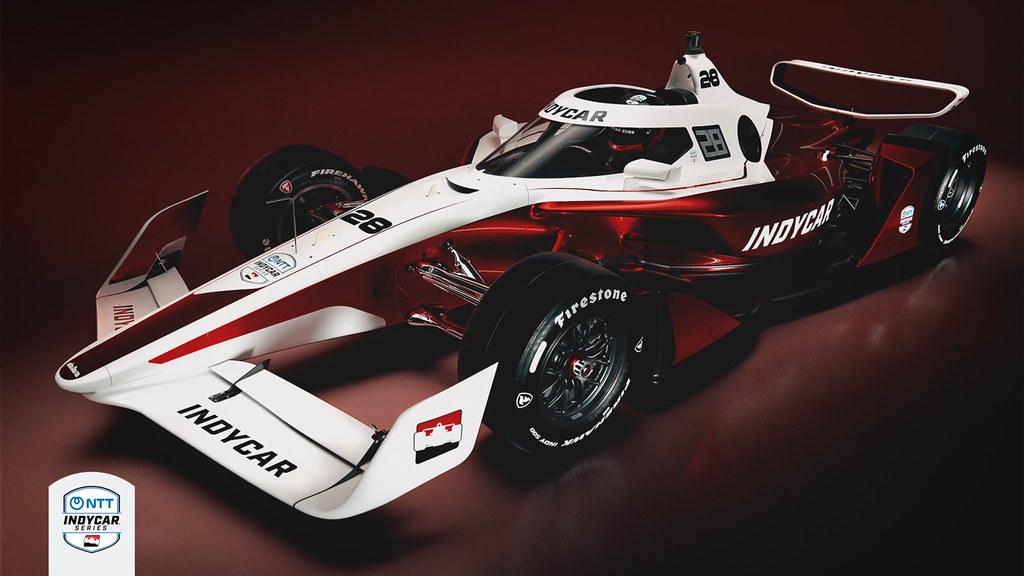 Photo By Penske Entertainment
The drivers who have already seen the car in person agreed that the design retains the series' visual identity but with a much more modern execution. Alex Palou commented that the important thing is to keep the close racing that makes IndyCar special. Alexander Rossi said the look is incredible and that now the key will be to see how it performs on track. Felix Rosenqvist valued that Dallara had listened to the requests of those sitting in the cockpit and highlighted the extra space in the cabin. Marcus Ericsson went further, saying he would have climbed in today if they had let him.
The renders show a car that retains a family resemblance to the machines fans have been watching for years, but the fine detail reveals that not a single part is inherited from the DW12. Testing begins this week at Indianapolis, Sebring and other tracks, and the series already warns that lap times will drop on every circuit, including the Indianapolis oval, where Arie Luyendyk's record has stood since 1996. The official presentation of the IR-28 comes less than two weeks before the Portland Grand Prix, the 13th round of the 2026 season, but the paddock's focus is already on a car that will not race for another two years. The DW12 worked as a cost‑containment platform and as the foundation of a closely contested show, but its fourteen years of service make it clear that the wait for a new chassis was far too long.
-
 Carlos Castillo Sansabas

Drivers Standings 2026
| POS | PILOTO | PTS | ↕ |
|---|---|---|---|
| 1 | Álex Palou | 631 | |
| 2 | Kyle Kirkwood | 545 | arrow_up1 |
| 3 | Christian Lundgaard | 535 | arrow_down1 |
| 4 | Pato O'Ward | 522 | |
| 5 | David Malukas | 514 | |
| 6 | Scott McLaughlin | 482 | |
| 7 | Marcus Ericsson | 429 | arrow_up1 |
| 8 | Josef Newgarden | 423 | arrow_down1 |

Antonelli suma su octava victoria del año en el debut del Madring

Norris Takes Pole in Formula 1's Debut at Madrid

McLaughlin Wins at Laguna Seca and Ends 2026 with a Victory for Penske

Antonelli Comes from the Back of the Pack to Win at Monza

Gasly's Pole at Monza Leaves Ferrari Out of the Front Row

Mick Schumacher will race for Meyer Shank Racing in 2027

Pato O’Ward Wins Both IndyCar Races in Milwaukee

Kyle Kirkwood Wins the Freedom 250 in Washington, D.C., and Palou Falls Behind

Alex Palou Takes Pole Position for the Freedom 250 in Washington, D.C.

Marcus Ericsson Wins in IndyCar's Debut in Markham, Ontario

Alex Palou Wins in Portland and Is Close to His Fourth Championship
