Red Bull Advanced Technologies will run the RB17 in front of the public at the 2026 Goodwood Festival of Speed, the first time the hypercar designed by Adrian Newey will complete ascents in front of spectators since development began more than five years ago. The runs on the 1.86‑kilometre hillclimb are part of the testing and validation programme the model still has active before the first customers receive their units. Isack Hadjar, full‑time driver for Oracle Red Bull Racing, test and reserve driver Yuki Tsunoda, Alisha Palmowski from the Red Bull Racing Academy Programme, and Newey himself will share the car over the weekend.
 Photo By Red Bull Content Pool
The RB17 is the last project that Newey led within the structure before leaving for Aston Martin. His departure, announced in May 2024, included a transition period in which the designer focused on finalising the concept and architecture of the car. From 2025 onward, development passed to the team led by Rob Gray, technical director of Red Bull Advanced Technologies, who oversaw the validation, testing and production launch phases. Gray said one of the aspects he is most proud of is how faithful the finished product turned out to be to the original vision, and the numbers help explain why: a Cosworth 4.5‑litre naturally aspirated V10, more than 1,200 horsepower combined with the hybrid system, less than 900 kilograms, and a rev limit of 15,000 rpm.
 Photo By Red Bull Content Pool
Since it did not have to comply with any competition regulations, the RB17's aerodynamics reached a level that the rules do not allow. It features ground effect with Venturi tunnels, active aerodynamics and active suspension, something that has been banned in Formula 1 for decades. That is why Red Bull estimates lap times similar to those of a top‑category single‑seater on many circuits, something no other customer car has achieved without passing through technical scrutineering. The price of each of the 50 planned units is around five million pounds, and includes access to a support programme with maintenance, engineering and track events managed by Red Bull itself.
The choice of name has a parallel history that team followers will recognise instantly. The designation sequence of the Milton Keynes single‑seaters skipped the RB17 because in 2021 they competed with the RB16B, so the number was reserved for this hypercar. There is also a technical kinship with the Aston Martin Valkyrie. That project was born from a collaboration between Red Bull and Aston Martin with Newey leading the design, but the Valkyrie was constrained by homologation requirements for road use. The RB17, conceived as track‑only from the outset, removed those constraints and allowed solutions that were not viable on the Valkyrie.
 Photo By Red Bull Content Pool
Although the hypercar name might be misleading, the RB17 is not related to the WEC Hypercar category or the LMH or IMSA LMDh prototypes. It was not designed to meet any sporting regulations. With 1,200 horsepower, less than 900 kilograms and unrestricted aerodynamics, it is much closer to a Formula 1 car than to a Ferrari 499P or a Porsche 963, which are limited by Balance of Performance and regulations that set weights above one tonne and power outputs below 700 horsepower. Adapting it to a specific category would require a near‑total redesign.
 Photo By Red Bull Content Pool
Goodwood will also see the 2013 RB9 complete demonstration runs, a car that won thirteen of nineteen races in the hands of Sebastian Vettel and gave Red Bull its fourth consecutive constructors' championship. Laurent Mekies, team principal, said the festival brings together the organisation's heritage with the innovative capability of its people, and the presence of both vehicles on the same asphalt within a few hours is precisely intended to do that. The RB17 will be positioned near the start line when it is not climbing the hill, allowing fans to examine it up close without the usual barriers of a Grand Prix. Goodwood is distinguished by that closeness: mechanics work in full view of the public, and it is common to cross paths with drivers from all eras walking among the attendees, a format that does not exist on a conventional race weekend.
-
 Carlos Castillo Sansabas


Paul Jourdain Wins Both GTM Races at the Autódromo de León

Helio Meza Wins Race 1 and José Arellano Wins Race 2 of the GTM in Chihuahua

Jourdain Wins Twice at the Hermanos Rodríguez Circuit and Takes the Lead in GTM

The 2026 Goodwood Festival of Speed wraps up with Romain Dumas winning the hill climb and Lando Norris as the main attraction

The 2026 Goodwood Festival of Speed will bring together 694 vehicles
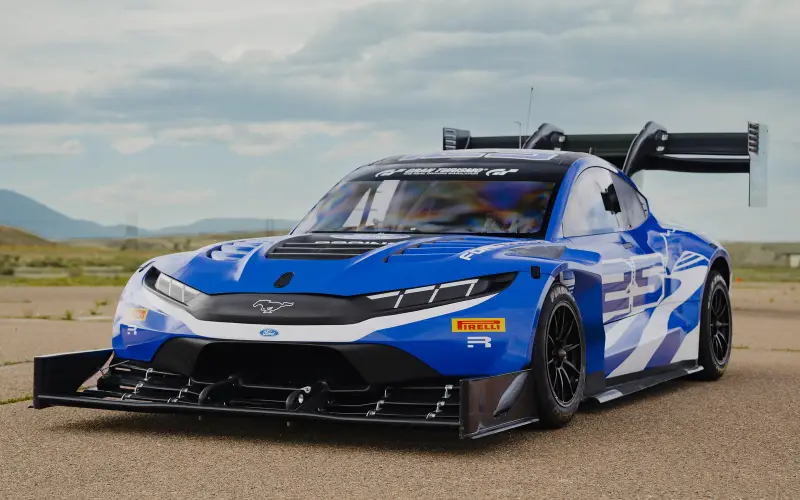
Romain Dumas Wins His Sixth Pikes Peak Race in the All-Electric Ford Super Mustang Mach-E

Woodgood Festival of Speed 2024: Details and Activities

McMurtry Spéirling PURE breaks record at Hockenheim

Mustang Super Cobra Jet 1800 Sets a New Record

Ford SuperVan 4.2 breaks records at Mount Panorama

Ford Performance Reveals F-150 Lightning Switchgear
