The 2026 Dakar Rally is revolutionizing its traditional format with a route featuring 4,900 kilometers of timed sections —the most extensive in years— which compensates for the removal of the 48-hour stage and the absence of the Empty Quarter through a novel double marathon-bivouac stage system. The official presentation in Jeddah, attended by Yazeed Al-Rajhi, the first Saudi Dakar champion, confirmed that the competition will be held from January 3 to 17, starting and finishing in Yanbu.
The 433 registered vehicles (118 bikes, 73 Ultimate, 46 trucks, 38 Challengers, 43 SSVs, and 8 Stock) represent a record participation with 812 competitors from 69 nationalities. Spain leads the representation with 186 participants, followed by France (114) and Italy (69), demonstrating that the structural changes have not diminished interest in the world's most demanding rally-raid.
 Photo By -
David Castera, director of the Dakar Rally since 2019, justified the removal of the controversial 48-hour stage due to issues detected in 2025. "We had a small problem mainly with the car category. They stopped a lot last year at the end of the stages, they lost time voluntarily to start further back," explained Castera, referring to the maneuvers several teams used to manipulate their starting positions. The organization has not confirmed whether the mass start format used in previous editions will be maintained.
"We had a small problem mainly with the car category. They stopped a lot last year at the end of the stages, they lost time voluntarily to start further back"
Double Marathon
The structure of the 2026 Dakar introduces one marathon-bivouac stage per week, distributing the technical wear more evenly. The first will take place from January 7 to 8 between AlUla and Hail (stages 4-5), with 451 km timed for cars and 417 for bikes on the first day, followed by 372 km and 356 km respectively. The second marathon will connect Wadi ad-Dawasir with Bisha from January 13 to 14 (stages 9-10), with initial 410 km and 418 km, plus 421 km and 371 km in the second part.
During these stages, competitors will overnight in spartan bivouac camps where only assistance between participants is allowed, with no access to their professional technical teams. This format replaces the single 48-hour stage that generated controversy in previous editions.
 Photo By A.S.O
Record-Length Stages Compensate for Absence of Empty Quarter
The decision to avoid the Empty Quarter for the first time since 2020 reduces the dune component by 600 kilometers compared to 2025. The route compensates with the longest special stages in recent years. Stage 8, with 481 kilometers timed on a loop around Wadi ad-Dawasir —a city not visited by the Dakar since 2022— will be the longest test. It is followed by Stage 7 with 462 km timed (876 km total) immediately after the rest day in Riyadh scheduled for January 10.
"We are close to 5,000 kilometers in special stages, which is a lot. It's been a long time since we did so much. I think we are looking at one of the biggest ever, we are almost at 4,900 kilometers," emphasized Castera. Stage 6 towards Riyadh will maintain 331 kilometers entirely on sand, offering the main navigation challenge in dunes before the rest day.
 Photo By A.S.O
Complete Route 2026 Dakar Rally
Day Date Route Total Distance Special Characteristics
| Day | Date | Route | Total Distance | Special | Characteristics |
|---|---|---|---|---|---|
| Prologue | Jan 3 | Yanbu | 98 km | 23 km | Official start |
| Stage 1 | Jan 4 | Yanbu Loop | 518 km | 305 km | No bivouac change |
| Stage 2 | Jan 5 | Yanbu → AlUla | 504 km | 400 km | Rock formations |
| Stage 3 | Jan 6 | AlUla Loop | 666 km | 422 km | Canyon navigation |
| Stage 4 | Jan 7 | AlUla → Bivouac | 492-526 km | 417-451 km | First marathon (bikes/cars) |
| Stage 5 | Jan 8 | Bivouac → Hail | 417-428 km | 356-372 km | End first marathon |
| Stage 6 | Jan 9 | Hail → Riyadh | 920 km | 331 km | 100% sand and dunes |
| Rest | Jan 10 | Riyadh | — | — | Rest day |
| Stage 7 | Jan 11 | Riyadh → Wadi ad-Dawasir | 876 km | 462 km | Post-rest restart |
| Stage 8 | Jan 12 | Wadi ad-Dawasir Loop | 717 km | 481 km | Longest special |
| Stage 9 | Jan 13 | Wadi ad-Dawasir → Bivouac | 531-540 km | 410-418 km | Second marathon |
| Stage 10 | Jan 14 | Bivouac → Bisha | 417-469 km | 371-421 km | End second marathon |
| Stage 11 | Jan 15 | Bisha → Al Henakiyah | 882 km | 347 km | Complex navigation |
| Stage 12 | Jan 16 | Al Henakiyah → Yanbu | 718 km | 310 km | Final approach |
| Stage 13 | Jan 17 | Yanbu Loop | 141 km | 105 km | Rally closure |
Totals: 7,994 km (cars) / 7,906 km (bikes) | 4,840 km timed (cars) / 4,748 km (bikes)
Separated Routes for Safety
Four days will feature completely separate routes between FIM (bikes) and FIA (cars) categories, a measure implemented to improve safety after multiple incidents when both categories shared tracks in reduced visibility conditions. This separation allows optimizing the routes according to the specific characteristics of each category, reducing collision risks and improving the competition's flow.
Saudi Next Gen Debuts in Official Competition
The impact of Yazeed Al-Rajhi's 2025 victory materializes with the competitive debut of the first graduates from the Saudi Next Gen program. Hamza Bakhashab (21 years old) with co-driver Fahad Alamr, and Abdullah Alshegawi (27) with Raed Alassaf, will compete in SSVs with Can-Am Maverick XRS Turbo under the BE Racing structure.
The program continues with five additional crews selected from 50 candidates across various motorsport disciplines, who will receive intensive training with Edo Mossi as instructor during the five days preceding the rally in Yanbu. Saudi participation is expected to grow from 16 competitors in 2025 to over 20 in 2026.
Mission 1000 Expands Electric Presence
The third edition of the Mission 1000 challenge incorporates seven 100% electric motorcycles that will compete on a specific route of 1,071 kilometers with daily stages of approximately 100 km. The Segways return with higher capacity batteries, the Arctic Leopards now operated by three Spanish riders in a private structure, and the commercially successful Stark Future with two independent projects. The KH7 truck maintains its hybrid hydrogen and biodiesel system, having achieved the highest scores in the two previous editions.
Dakar Classic Breaks Records
The Dakar Classic reaches its sixth edition with over 100 historic vehicles expected (75 cars, 7 bikes, and 24 trucks confirmed), setting a record of 7,281 total kilometers with 4,162 km in special stages. The regularity competition introduces "Super Regularity Tests" and a final "Power Stage" to increase the technical challenge.
W2RC 2026: Fifth Season of the World Championship
The Dakar opens the fifth season of the World Championship, where Daniel Sanders dominated in bikes in 2025 (4 out of 5 rallies, 16 of 37 specials) and Lucas Moraes was crowned champion in the FIA Ultimate category.
W2RC 2026 Calendar:
- Jan 3-17: Dakar Rally (Saudi Arabia) - Season opener
- Mar 17-22: BP Ultimate Rally Raid (Portugal) - Mixed European terrain
- May 24-29: Desafío Ruta 40 (Argentina) - Altitude and Andean navigation
- Sep 28-Oct 3: Rallye du Maroc - African pre-Dakar preparation
- Nov 22-27: Abu Dhabi Desert Challenge - Finale in Emirati dunes
Upcoming Races


Ford Returns to the WRC as a Manufacturer

FIA Removes Saudi Arabia from the 2026 WRC Calendar

Toyota Wins Its Tenth Manufacturers' Title at the Rally Chile

Oliver Solberg Leads the Rally Chile Bio Bío Going into the Final Day

Sami Pajari Wins in Paraguay, Securing His Third Consecutive Victory in the WRC

The WRC Paraguay Rally Kicks Off with Pajari in the Lead and Two Withdrawals

Toyota will bring a hydrogen-fuel-cell Hilux to the 2027 Dakar Rally
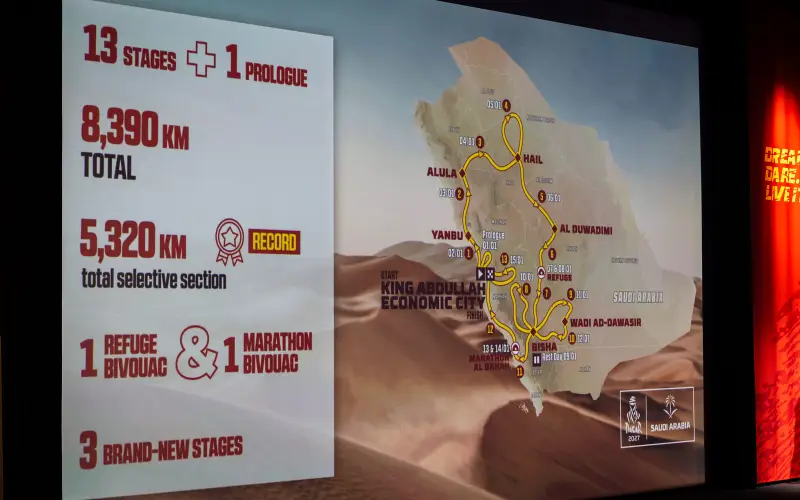
The 2027 Dakar Rally will exceed 5,000 km of special stages for the first time
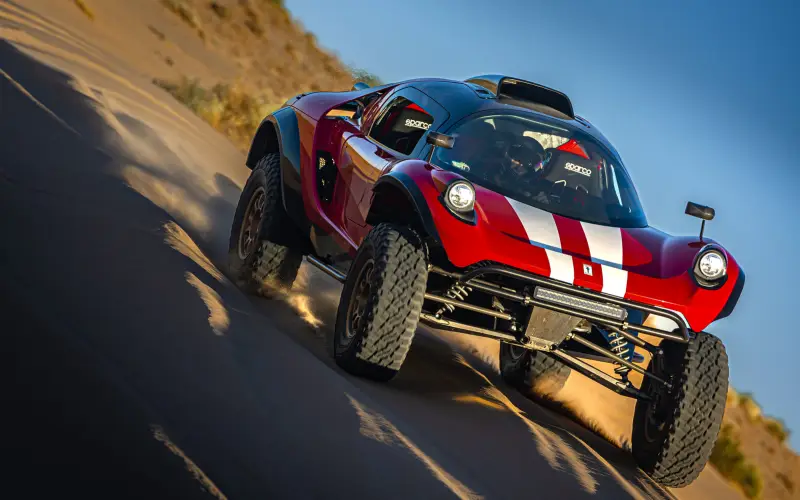
Glickenhaus is bringing its WEC development to off-road racing with the SCG 008

Nasser Al-Attiyah wins the 2026 Dakar Rally with Dacia

Nasser Al-Attiyah wins penultimate stage of Dakar 2026
