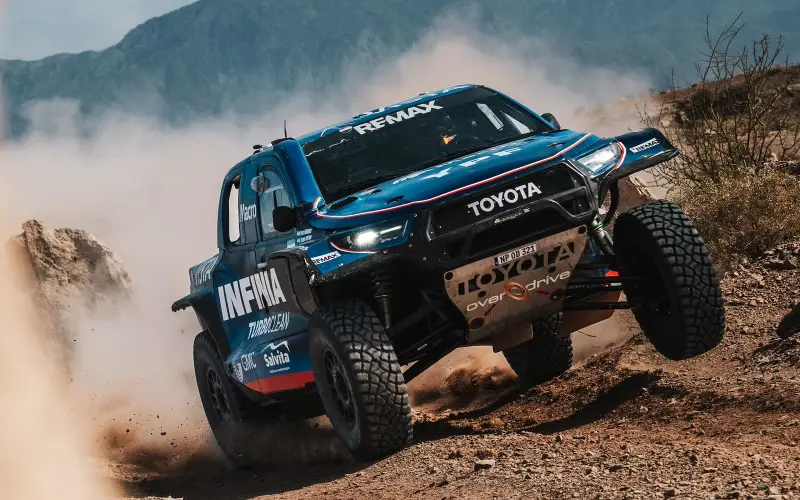
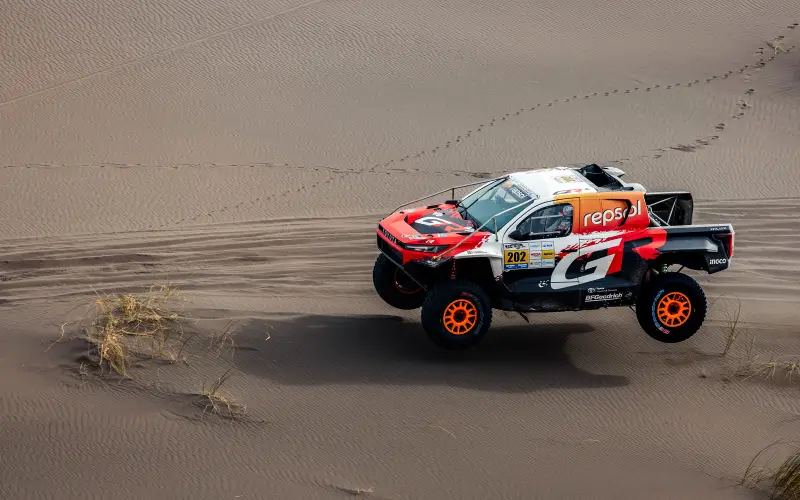
EBRO will participate in the 2026 Dakar Rally with an official team and a 4x4 vehicle that complies with T1+ regulations. The Spanish brand will compete in the premier category of the FIA World Rally-Raid Championship (W2RC) for the first time since its revival in 2023.
The T1+ category includes Ford & M-Sport with the Ford Raptor T1+, Dacia & Prodrive with the Dacia Sandrider, and Overdrive Racing with the Toyota Hilux Overdrive.
Return after four decades of absence
The brand previously participated in the Dakar during the early 1980s when it was part of Motor Ibérica. At that time, several EBRO trucks competed in the heavy vehicles category, entered by private and semi-official teams.
The results weren't remarkable compared to dominant brands like Tatra, DAF or Mercedes-Benz, but served to test industrial platforms in extreme conditions. Participation was sporadic and didn't continue until the brand's disappearance in 1987.
 Photo By EBRO
Electric precursor in 2022
EBRO had already connected with the race in 2022, when it presented a fully electric SSV as the 0 car in Dakar Future. This initiative was the first sign of the brand's return following its reestablishment.
Motor Ibérica created the brand in 1954 after inheriting Ford Spain
EBRO was one of Spain's most important automotive brands of the 20th century. Founded in 1954 by Motor Ibérica, heir to Ford's Spanish subsidiary, it became synonymous with commercial and utility vehicles in Spain during the 1960s and 1970s.
The brand manufactured everything from heavy trucks to vans, off-road vehicles, buses, and agricultural tractors. Its vehicles were omnipresent on Spanish roads: from urban delivery to freight transport and agricultural work. EBRO exported to more than 60 countries, establishing itself as a national benchmark in the industrial sector.
For several generations of Spaniards, EBRO represented the national automotive industry. Its trucks and vans were part of everyday life, especially in professional and agricultural settings.
The decline came with Nissan's entry as a shareholder between 1979 and 1986. The brand was gradually absorbed until disappearing as an independent entity in 1987, remaining inactive for 36 years.
Resurrection with Chinese technology
In 2023, EBRO was reborn as Ebro-EV Motors through a joint venture between Spanish company EV Motors (formerly EcoPower Automotive) and Chinese manufacturer Chery. The partnership uses facilities at the former Nissan plant in Zona Franca, Barcelona, modernized to assemble vehicles using the CKD system.
The company has launched production of three models: the electric Pick-Up (since Q4 2024) and the S700 and S800 SUVs, based on the Chery Tiggo 7 and Tiggo 8 respectively, whose assembly began in November 2024.
Projections toward 2029
EV Motors, which debuted on BME Growth in October 2024, projects reaching annual production of 150,000 vehicles by 2029. The total investment amounts to 400 million euros, with plans to complete local manufacturing after summer 2025.

Upcoming Races
Drivers Standings 2026
| POS | PILOTO | PTS | ↕ |
|---|---|---|---|
| 1 | Sébastien Loeb | 114 | |
| 2 | Nasser Al-Attiyah | 111 | |
| 3 | Seth Quintero | 101 | |
| 4 | Nani Roma | 59 | |
| 5 | Lucas Moraes | 57 | |
| 6 | Henk Lategan | 56 | |
| 7 | Mattias Ekström | 53 | |
| 8 | Joao Ferreira | 52 |
Manufacturers Standings 2026
| POS | CONSTRUCTOR | PTS | ↕ |
|---|---|---|---|
| 1 | The Dacia Sandriders | 315 | |
| 2 | Toyota Gazoo Racing W2Rc | 250 | |
| 3 | Ford Racing | 175 |

The WRC confirms a 15-rally calendar for 2027

Elfyn Evans Wins the 2026 WRC Title at the Rally Italia Sardegna

Ford Returns to the WRC as a Manufacturer

FIA Removes Saudi Arabia from the 2026 WRC Calendar

Toyota Wins Its Tenth Manufacturers' Title at the Rally Chile

Oliver Solberg Leads the Rally Chile Bio Bío Going into the Final Day

The W2RC announces its 2027 schedule with five events
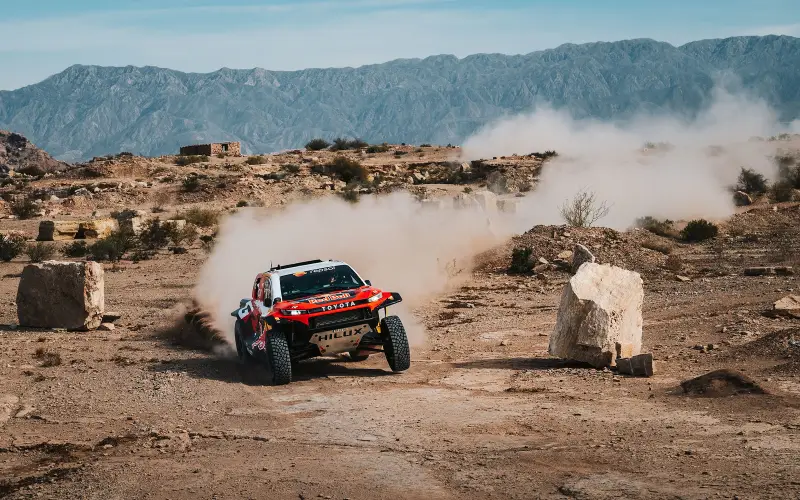
Seth Quintero wins the Desafío Ruta 40, his first victory in Ultimate
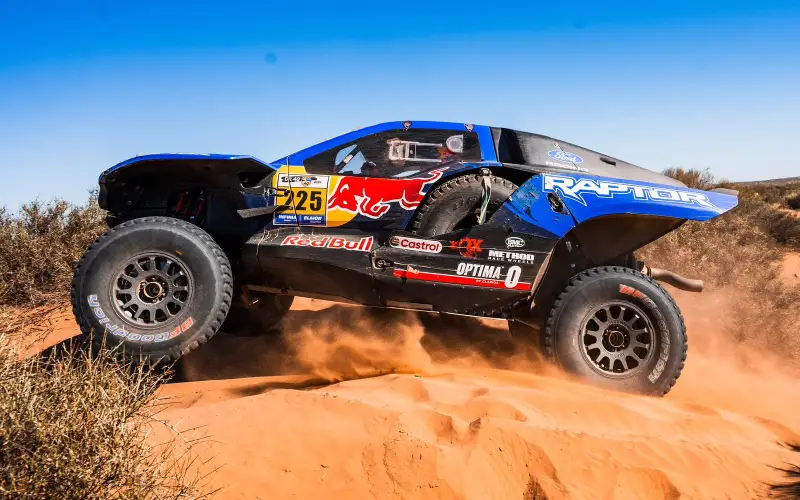
Sainz wins Stage 4 and Quintero is the new leader of the Desafío Ruta 40
Henk Lategan wins Stage 3 of the Ruta 40 and takes the lead
Al-Attiyah wins the second stage of the Desafío Ruta 40